Enterprise ops visibility without another system silo
Enterprises rarely lack software. Finance has a system. Sales has a system. Delivery has a system. Support has a system. The problem appears when a result depends on all four. Each tool shows a valid local state, but no tool explains the full journey.
This gap creates meetings, spreadsheet trackers, status requests, and manual escalation. People become the integration layer. Leaders see progress after it has been summarized, often too late to change the outcome. Enterprise ops is the discipline of making cross-team execution legible while work is still happening.
WRKSHP starts with the operating question, not the dashboard. Which outcomes cross boundaries? Which events change responsibility? Which approvals matter? Which exceptions need action? Only then do we define the data and interface required for a shared view.
State
What has actually happened, based on evidence from the source system?
Ownership
Which person or team owns the next action, decision, or recovery?
Exception
What is outside the expected path, and how long has it remained there?
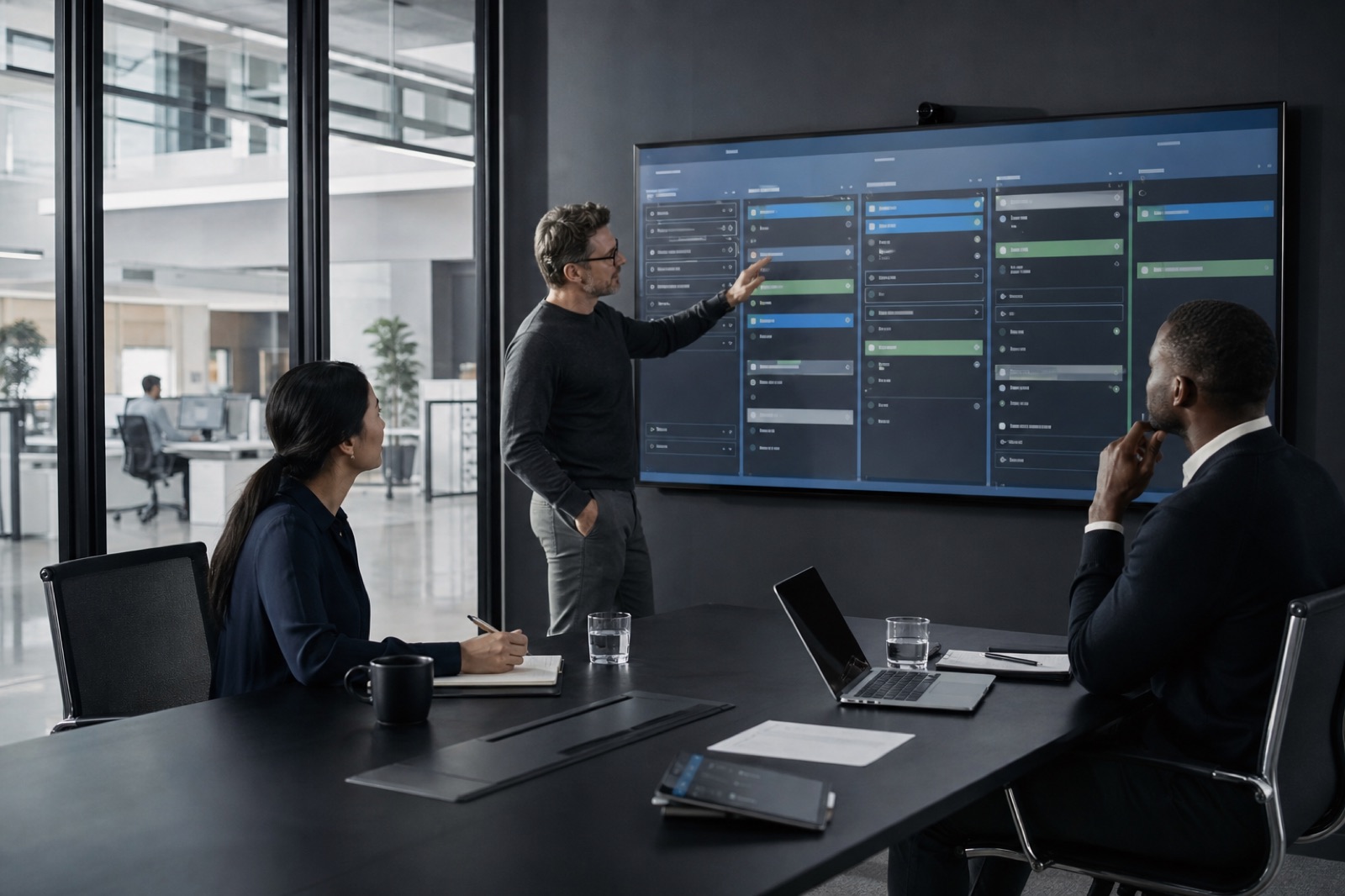
Cross-team work fails in the handoff
A team can hit every local target while the enterprise misses the customer or financial outcome. Handoffs fail when completion is defined differently, required context is missing, or the receiving team does not know it now owns the work.
The answer is not more reporting. It is a precise operating contract around state, evidence, ownership, and time. That contract becomes the foundation for enterprise ops.
Request
Define what entered the workflow and what outcome it requires.
Accept
Make receipt explicit. Silent queues hide operational debt.
Decide
Record approval, rejection, exception, and the reason.
Deliver
Attach evidence that the downstream result exists.
Recover
Route stalled work with context before a customer escalates.
Visibility that respects authority
Enterprise ops should never mean that everyone can see or change everything. The model separates awareness from authority. An executive may need portfolio state. An operator may need a queue. A reviewer may need evidence. An administrator may need configuration and audit access.
We define these views with security and governance in mind. The NIST Cybersecurity Framework offers a useful public reference for organizing risk outcomes. The implementation still needs to reflect your own policies, systems, and responsibilities.
| View | Question answered | Control |
|---|---|---|
| Executive | Where is outcome risk rising? | Read and escalate |
| Operator | What needs action now? | Work assigned scope |
| Reviewer | What evidence supports this decision? | Approve or return |
| Administrator | Who can do what? | Configure and audit |
Build the shared view in bounded phases
Start with one workflow that crosses meaningful boundaries. Observe how it runs today. Define the minimum shared state. Connect only the events needed to answer operational questions. Put the view in front of the people who act. Then learn from real exceptions before expanding.
This sequence protects the project from becoming a universal data program. Enterprise ops succeeds when teams use it to make better decisions, not when a warehouse contains more rows. Every phase should improve a real handoff, shorten a decision loop, or make a risk visible earlier.
WRKSHP can design the operating model and build the supporting software through our enterprise software practice. For broader growth execution, see Growth OS. For the full capability map, visit services.
Enterprise operations visibility questions
What is enterprise operations visibility?
It is a shared, role-aware view of work, state, ownership, approvals, exceptions, and evidence across the systems teams already use.
Does this require replacing every system?
No. Strong systems of record can remain in place. The operating layer connects selected events and presents the cross-team state people cannot see today.
Where should we start?
Choose one workflow where delay, rework, or unclear ownership has a meaningful consequence.
How is access controlled?
Access is designed around roles, teams, sensitivity, and actions. Viewing, deciding, changing, and exporting are treated as separate permissions.
See execution before the escalation.
When systems show local truth but leaders still chase the full story, discuss execution visibility with WRKSHP.
Discuss execution visibility